By Dr. Rosie Hodges
One of the most common questions families ask us is:
“How long will my child need speech therapy?”
The honest answer is that every child is different.
Some children achieve their goals within a few months. Others require support across different stages of their development. As children’s needs change, the type of support they need often changes too.
At Word Stars, we don’t believe therapy should continue indefinitely without a clear purpose. Instead, we use a block therapy model that focuses on personalised goals, measurable progress, and choosing the right support at the right time.
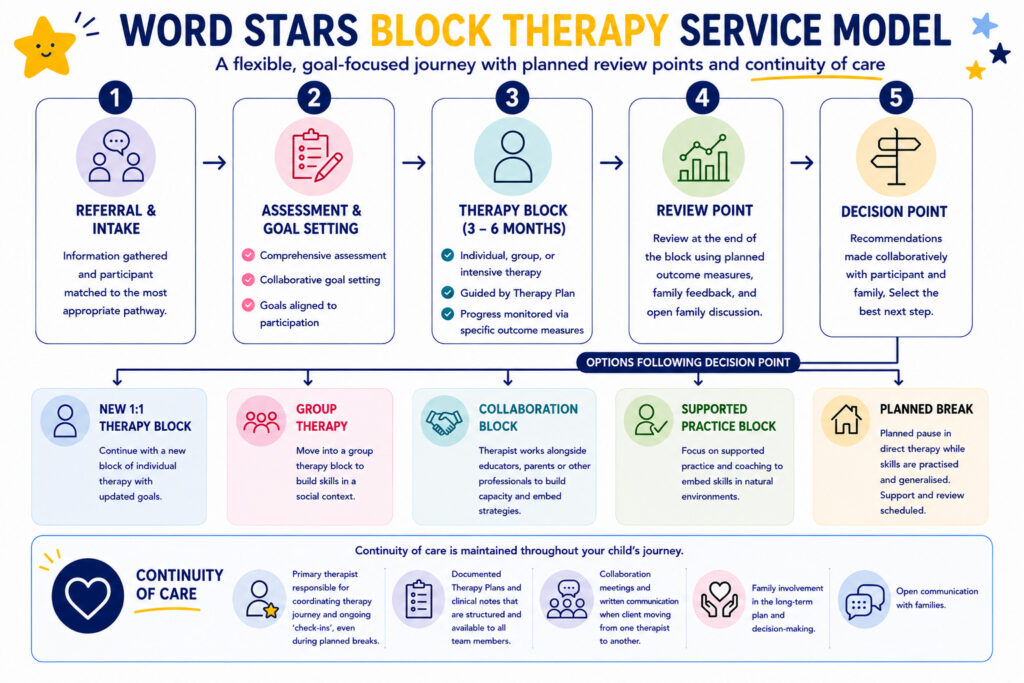
Every child’s journey begins with an assessment and collaborative goal-setting process. Together with families, we develop clear goals and identify how progress will be measured. This helps ensure everyone is working towards the same outcomes from the very beginning.
Children then participate in a therapy block, typically lasting between three and six months. Depending on their goals, this may include individual therapy, group therapy, or an intensive therapy program. Throughout the block, therapists monitor progress using planned outcome measures so we can clearly see what is working and where adjustments may be needed.
At the end of each therapy block, we review progress with families. We look at outcome data, discuss family feedback, celebrate progress, and make collaborative decisions about what should happen next.
Importantly, the next step is not always “more therapy.”
Some children benefit from another individual therapy block. Others may be ready for a group program to practise their skills with peers. Some families move into a collaboration block, where therapists work closely with schools, educators, or support teams to help embed strategies in everyday environments. Others may complete a supported practice block, which focuses on helping children and families use their skills more independently.
Sometimes the best option is an intentional therapy break. During these breaks, children have opportunities to consolidate and generalise their skills in real-life situations before returning for a review if needed.
Throughout the entire journey, continuity of care remains a priority. Each family has a primary therapist who helps coordinate their therapy journey, monitors progress, and supports decision-making over time. Therapy plans and clinical notes are available to relevant team members, and when children transition between therapists or services, collaboration meetings and written handovers help ensure a smooth experience.
Most importantly, families are involved in long-term planning and decision-making every step of the way.
Because children’s needs change over time, we believe therapy should too.